Accelerated Oblique Random Survival Forests

{aorsf}: Like ORSF, but A

Lukas Burk

What is {aorsf}?

  • Improvement on {obliqueRSF} (Oblique Random Survival Forests) by the original author
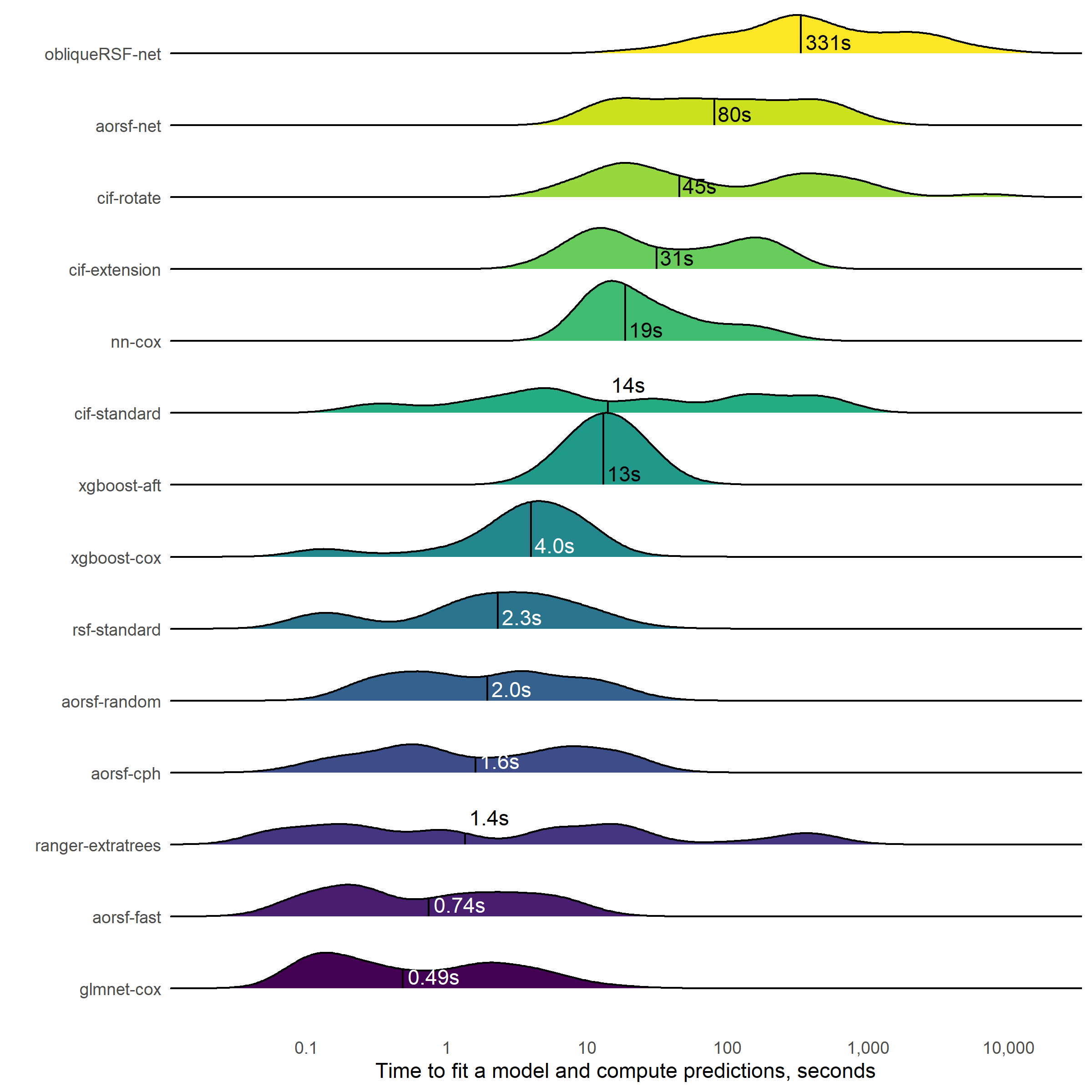
  • {obliqueRSF} is orders of magnitude slower than other RSF implementations, did not scale to larger datasets
  • {obliqueRSF} explicitly states it’s superseded by {aorsf}
  • -> More of a software improvement rather than a new method

Why is it interesting?

A Quick Overview of Oblique RSF

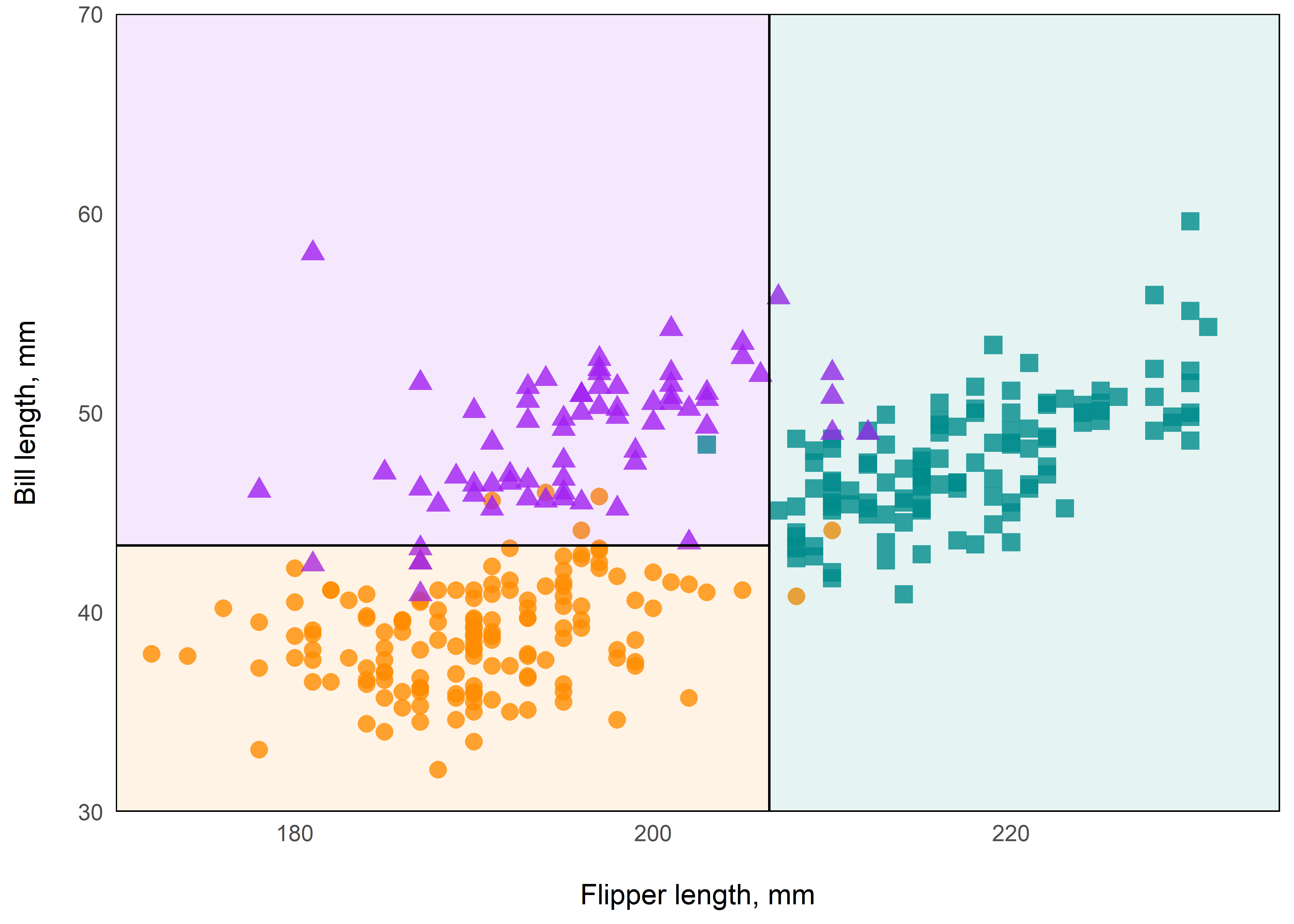
Regular splitting

Orthogonal decision boundaries
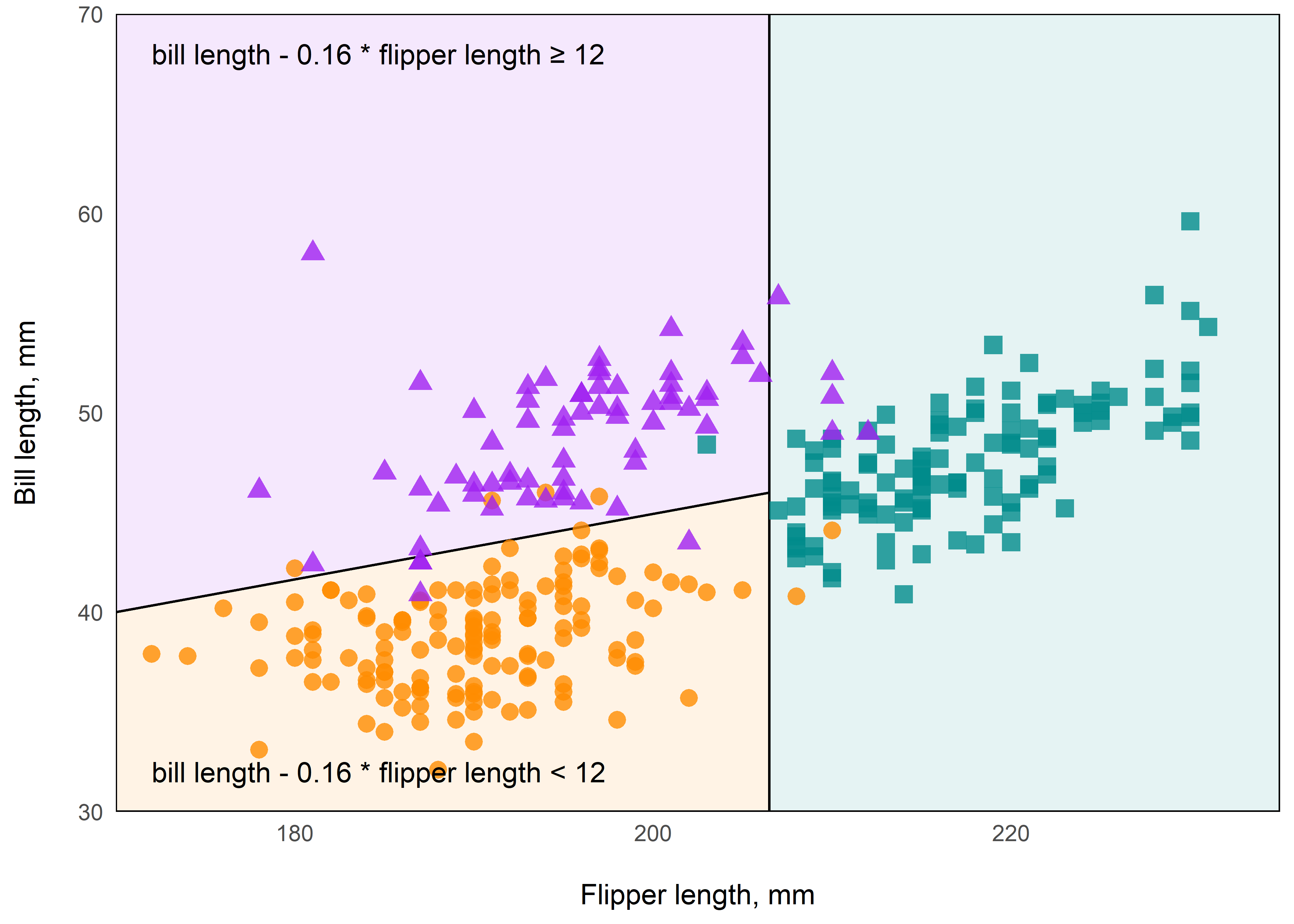
Oblique splitting

Linear but not orthogonal
Accelerating ORSF

{obliqueRSF}

  • Oblique splits are based on linear combinations of predictors
  • Splits based on Cox regression model in (non-leaf) nodes
  • Uses glmnet to identify linear combinations
  • Adds flexibility, increases computational cost

{aorsf}

  • {aorsf} applies Newton-Raphson scoring to partial Cox-likelihood
  • Fastest (default) version: Only one NR iteration
  • Also available:
    • Using NR until convergence
    • Using {glmnet}, similar to {obliqueRSF}

Interface

library(aorsf)

fit <- orsf(data = pbc_orsf, # Built-in variant of survival::pbc
            formula = Surv(time, status) ~ . - id,
            oobag_pred_horizon = 365.25 * 5)
fit
---------- Oblique random survival forest

     Linear combinations: Accelerated
          N observations: 276
                N events: 111
                 N trees: 500
      N predictors total: 17
   N predictors per node: 5
 Average leaves per tree: 24
Min observations in leaf: 5
      Min events in leaf: 1
          OOB stat value: 0.84
           OOB stat type: Harrell's C-statistic
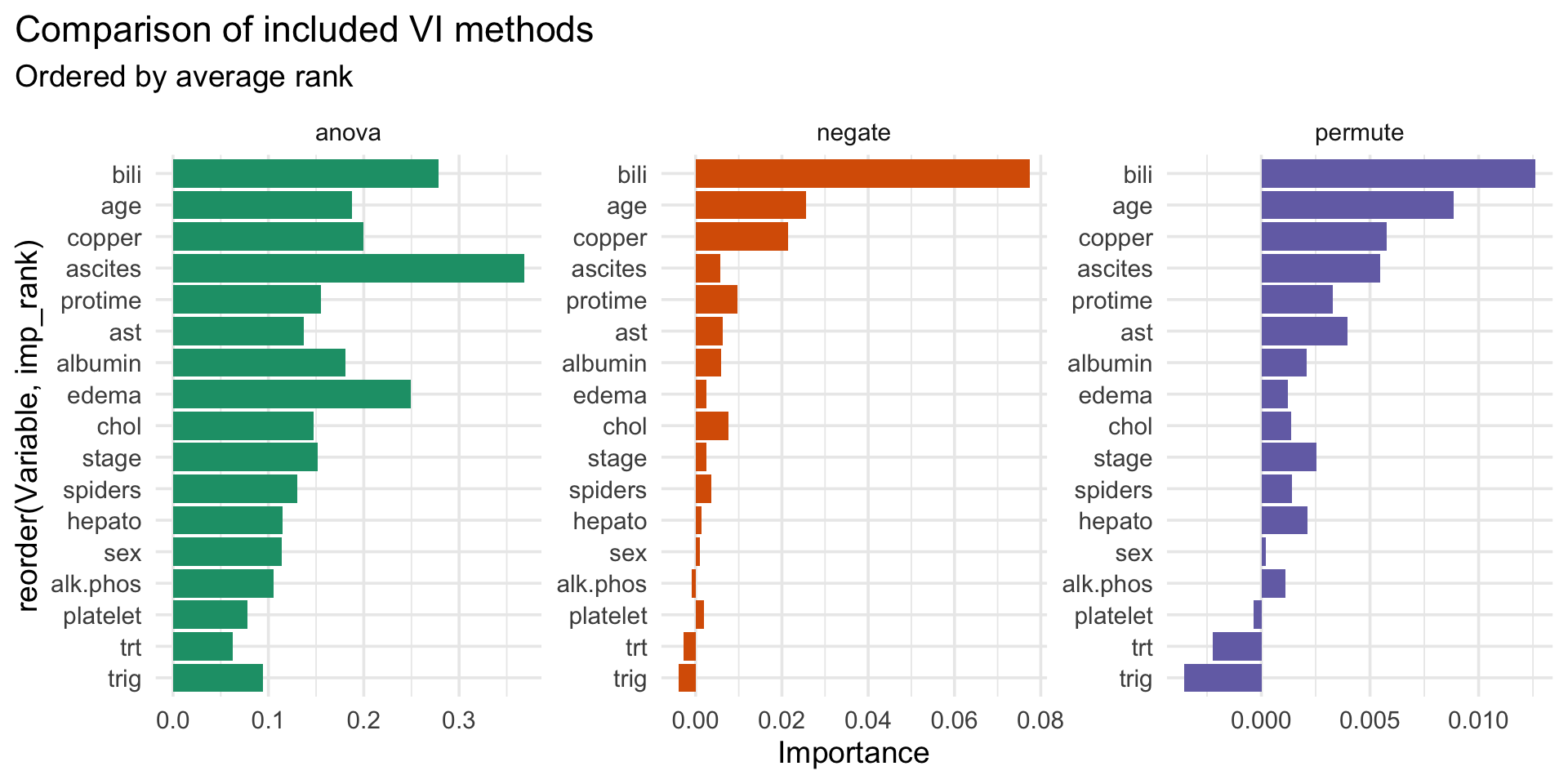
     Variable importance: anova

-----------------------------------------

Variable importance methods

importance = "anova" (default)
orsf_vi_anova(fit)

A p-value is computed for each coefficient in each linear combination of variables in each decision tree.

Importance for an individual predictor variable is the proportion of times a p-value for its coefficient is < 0.01.

This technique is very efficient computationally, but may not be as effective as permutation or negation in terms of selecting signal over noise variables.

Variable importance methods

importance = "negation"
orsf_vi_negate(fit)

Each variable is assessed separately by multiplying the variable’s coefficients by -1 and then determining how much the model’s performance changes.

The worse the model’s performance after negating coefficients for a given variable, the more important the variable.

This technique is promising b/c it does not require permutation and it emphasizes variables with larger coefficients in linear combinations,

but it is also relatively new and hasn’t been studied as much as permutation importance.

Variable importance methods

importance = "permutation"
orsf_vi_permute(fit)

Standard permutation feature importance,
as known from other R(S)F implementations

Variable importance methods

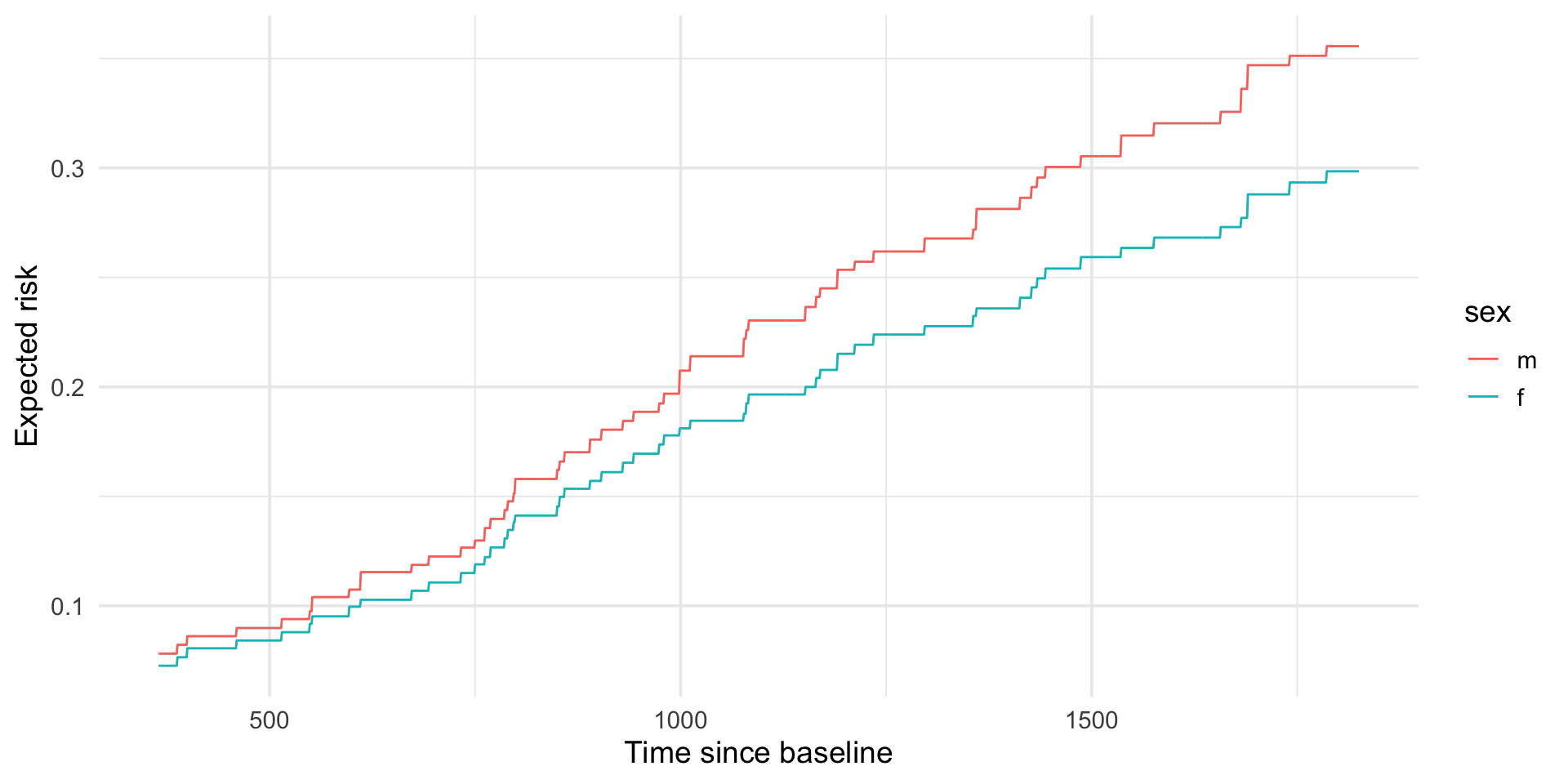
Interpretibility tools: Partial Dependence Plots

  • Using either in-bag, OOB or test-data
pd_sex_tv <- orsf_pd_oob(fit, pred_spec = list(sex = c("m", "f")),
                         pred_horizon = seq(365, 365*5))

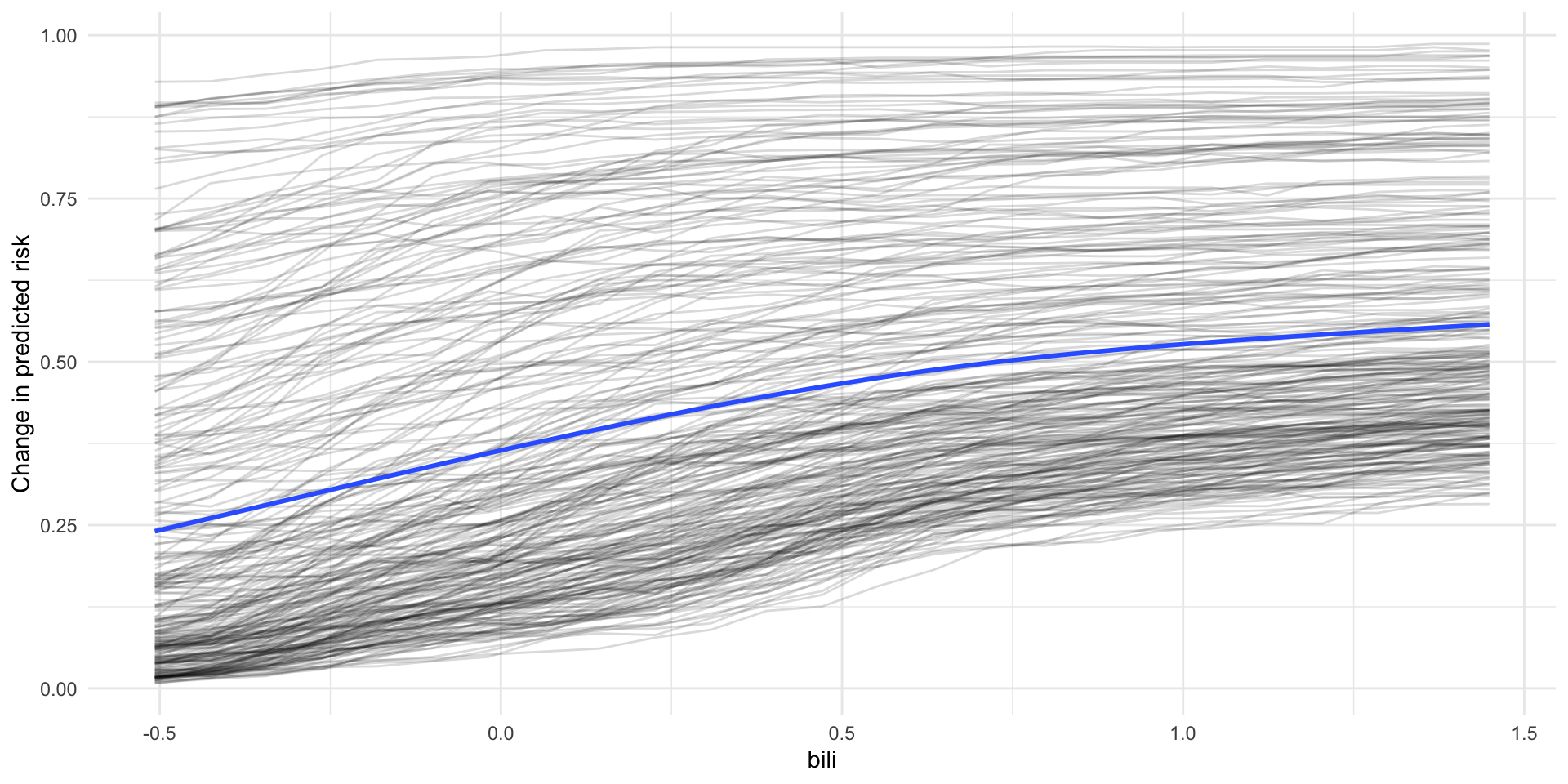
Interpretibility tools: ICE curves

pred_spec <- list(bili = seq(1, 10, length.out = 25))
ice_oob <- orsf_ice_oob(fit, pred_spec, boundary_checks = FALSE)

From Benchmark: Runtime

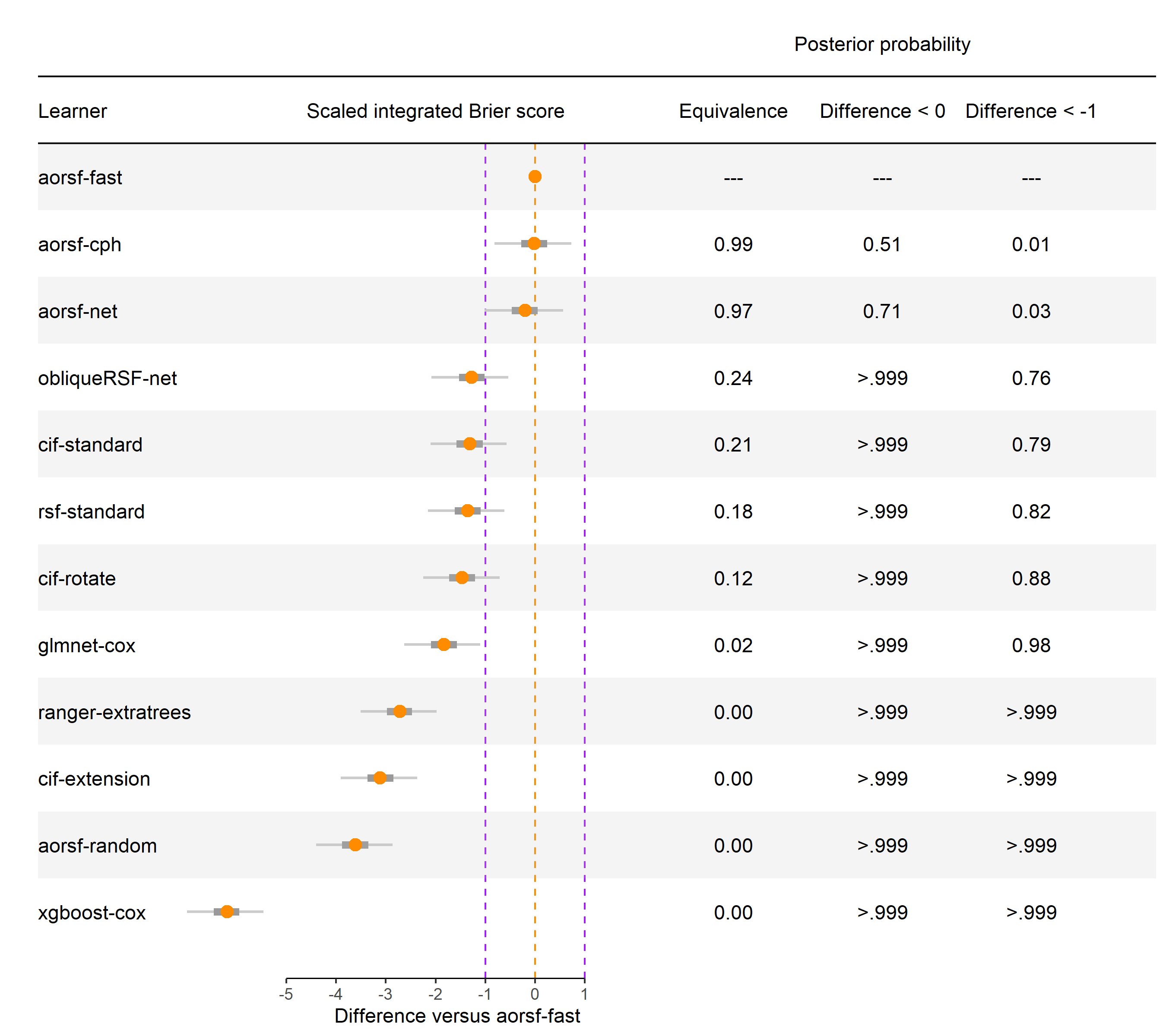
From Benchmark: Performance

  • Evaluated on IPA, based on IBS over q25 and q75 of survival times.
  • Uses Bayesian LMM: \(\mathrm{IPA} = \hat{\gamma} \cdot \mathrm{learner} + (1|\mathrm{data}/\mathrm{run})\)
Further Reading

Literature

  • Original paper on ORSF: Jaeger et al. (2019): “Oblique random survival forests”
  • Preprint on arXiv: Jaeger, Welden, Lenoir, Speiser, et al. (2022): “Accelerated and interpretable oblique random survival forests”
  • Software paper on JOSS: Jaeger, Welden, Lenoir, and Pajewski (2022)

References

Jaeger, Byron C., D. Leann Long, Dustin M. Long, Mario Sims, Jeff M. Szychowski, Yuan-I Min, Leslie A. Mcclure, George Howard, and Noah Simon. 2019. Oblique random survival forests.” The Annals of Applied Statistics 13 (3): 1847–83. https://doi.org/10.1214/19-AOAS1261.
Jaeger, Byron C., Sawyer Welden, Kristin Lenoir, and Nicholas M. Pajewski. 2022. “Aorsf: An r Package for Supervised Learning Using the Oblique Random Survival Forest.” Journal of Open Source Software 7 (77): 4705. https://doi.org/10.21105/joss.04705.
Jaeger, Byron C., Sawyer Welden, Kristin Lenoir, Jaime L. Speiser, Matthew W. Segar, Ambarish Pandey, and Nicholas M. Pajewski. 2022. “Accelerated and Interpretable Oblique Random Survival Forests.” arXiv. https://doi.org/10.48550/ARXIV.2208.01129.